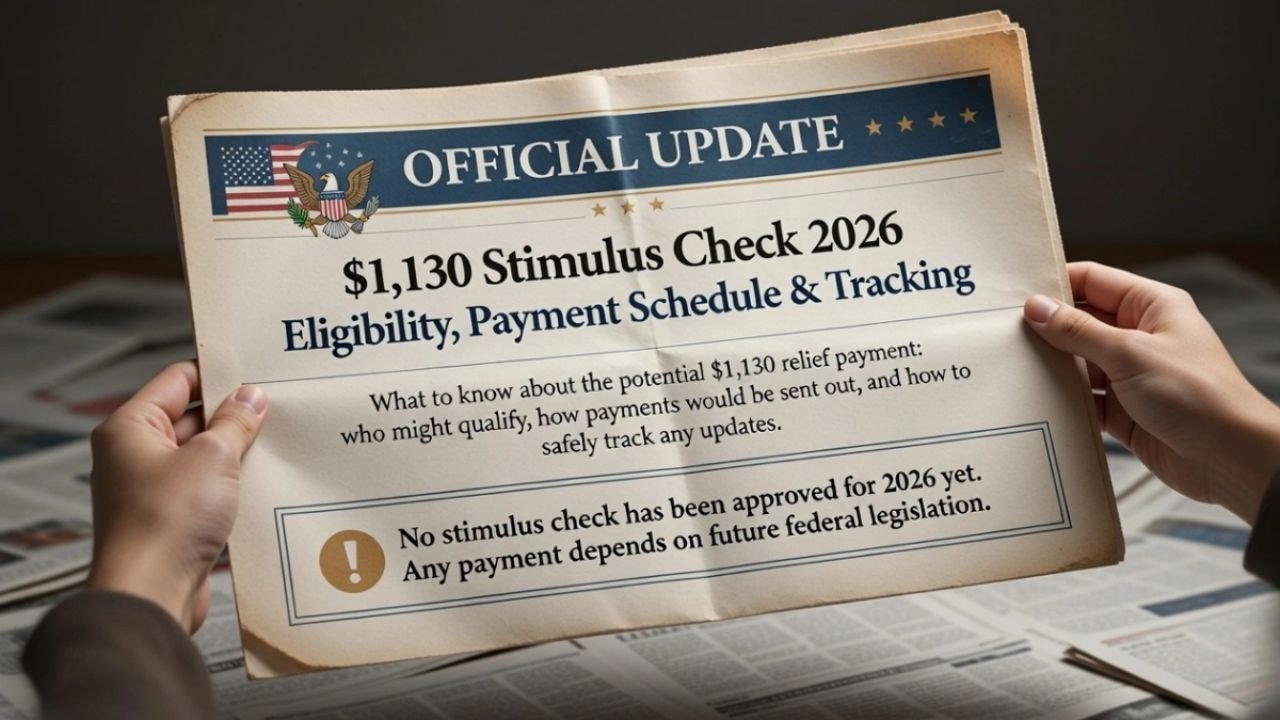
Talk of a $1,130 federal stimulus payment arriving in 2026 has gained rapid traction online. For many households navigating inflation, higher borrowing costs, and evolving tax rules, even the possibility of direct financial relief captures immediate attention.
But before adjusting budgets or expecting a deposit, it is essential to clarify what is officially confirmed — and what may be misunderstanding tied to routine tax refunds or existing federal programs.

Here is a clear, fact-based breakdown of the $1,130 stimulus claim, eligibility realities, and what taxpayers should genuinely expect in 2026.
Is a $1,130 Federal Stimulus Check Officially Approved?
At this time, there has been no formal congressional legislation authorizing a nationwide $1,130 stimulus check for 2026.
Large-scale federal payments require:
- Congressional approval
- Presidential signature
- Treasury allocation
- Administrative rollout through the Internal Revenue Service

Without enacted legislation and an official announcement published on verified government platforms, automatic stimulus payments cannot legally proceed.
When previous stimulus checks were approved, details were widely communicated through press briefings, IRS notices, and Treasury releases. The absence of similar confirmation suggests caution is warranted.
Why Is the $1,130 Figure Circulating?
There are several reasons a specific dollar amount like $1,130 may trend:
Tax Refund Confusion

Many refunds fall near that range depending on withholding levels and credits claimed.
State-Level Relief Programs
Some states occasionally issue rebate checks in fixed amounts, which can be misinterpreted as federal payments.
Social Media Amplification
Unverified financial claims often gain traction quickly, especially during tax season.
The key distinction: a refund or state rebate is not the same as a new federal stimulus initiative.
How Federal Stimulus Programs Actually Work
If Congress were to authorize a new stimulus payment, distribution would follow a structured process similar to past programs.
Direct Deposit First
Taxpayers with verified banking information on file would receive electronic transfers first. This is the fastest and most secure method.
Paper Checks
Recipients without direct deposit details would receive mailed checks.
Prepaid Debit Cards
In some cases, prepaid government-issued debit cards are mailed as an alternative.
Payments are typically distributed in batches to manage processing capacity and fraud prevention reviews.
Until legislation is passed, however, no such distribution schedule exists for a $1,130 payment.
Who Would Likely Qualify If Approved?
While no confirmed program currently exists, historical stimulus models suggest eligibility would likely depend on:
Income Limits
Adjusted Gross Income thresholds typically determine full eligibility, with phased reductions for higher earners.
Filing Status
Single, married filing jointly, and head-of-household filers are evaluated differently under federal formulas.
Citizenship and Social Security Number
Valid Social Security numbers and lawful residency are standard requirements.
Dependent Status
Eligibility may exclude dependents claimed on another taxpayer’s return unless specified in legislation.
Without formal policy details, however, any eligibility outline remains speculative.
Could the $1,130 Be a Tax Refund Instead?
For many taxpayers, a deposit around $1,130 may simply reflect their 2025 federal income tax refund.
Refund amounts depend on:
- Withholding throughout the year
- Earned Income Tax Credit qualification
- Child Tax Credit eligibility
- Deductions and adjustments
- Filing accuracy
A tax refund is not bonus money — it represents excess taxes paid or refundable credits applied to your account.
If you recently filed your return, February or March deposits are most likely standard refunds rather than new stimulus funds.
How to Verify Legitimate IRS Payments
The safest way to confirm payment status is through official IRS tracking tools and secure online accounts.
Key reminders:
- The IRS does not send unexpected stimulus deposits without legislative authorization.
- Official government websites end in “.gov.”
- The IRS does not request personal data via social media or unsolicited texts.
- No fee is required to receive a legitimate federal payment.
Financial vigilance protects both your funds and personal information.
What Should Taxpayers Do Now?
Instead of relying on speculative stimulus claims, focus on proactive financial preparation:
- File your 2025 federal tax return accurately and on time.
- Confirm your direct deposit information is correct.
- Monitor your IRS online account for updates.
- Review official announcements from verified government sources only.
These steps ensure you are positioned properly should any legitimate program be enacted.
The Bottom Line
At present, there is no officially confirmed nationwide $1,130 federal stimulus check scheduled for 2026.
While the idea of additional relief understandably attracts attention, federal stimulus payments require formal legislative action and transparent implementation through the Internal Revenue Service and the U.S. Treasury.
Many deposits arriving in early 2026 are far more likely to be routine tax refunds rather than newly authorized stimulus funds.
In today’s fast-moving digital environment, verified information is a financial asset. Make decisions based on confirmed policy — not trending headlines.
Disclaimer: Stimulus payment programs, eligibility criteria, and distribution timelines depend entirely on federal legislation and official government announcements. Taxpayers should consult verified IRS communications or qualified tax professionals for accurate and personalized guidance.