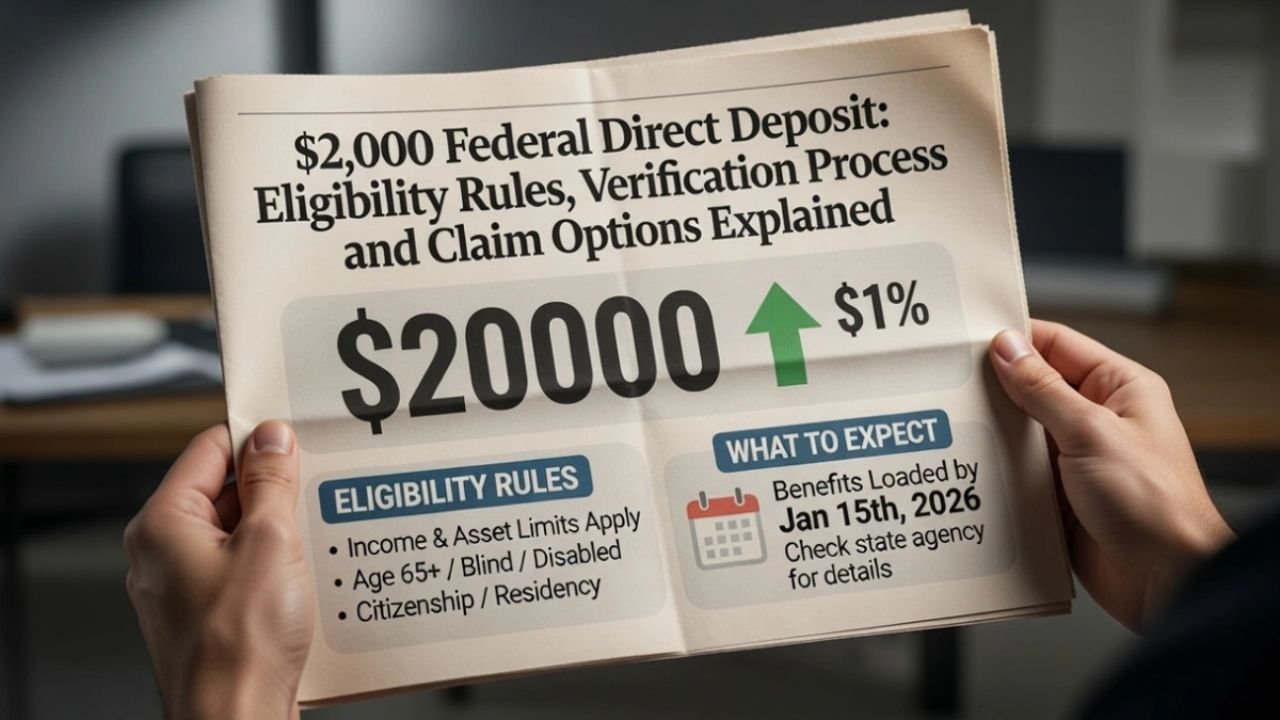
Talk of a potential $2,000 federal direct deposit has captured national attention. For households navigating elevated living costs, even the possibility of structured federal relief generates understandable interest. While any large-scale payment program depends on formal authorization, understanding how eligibility rules and claim procedures typically work can help you prepare in advance.
If approved, such payments would likely follow established federal distribution systems designed for speed, security, and fraud prevention.

Here is what eligibility, verification, and payment processing would generally involve.
How Federal Direct Deposit Programs Typically Work
When the federal government authorizes direct financial assistance, distribution is usually managed through the Internal Revenue Service or another designated federal agency. Tax return data becomes the primary tool for verifying eligibility and issuing payments efficiently.
Most modern relief programs prioritize direct deposit, as it minimizes administrative costs and ensures faster delivery compared to mailed checks.

While final program rules would depend on formal legislation, historical frameworks provide a strong indication of how a $2,000 payment initiative could operate.
Core Eligibility Requirements
Eligibility for a $2,000 federal deposit would likely be based on measurable financial and residency criteria. Although official thresholds would need to be confirmed, typical requirements include the following:
Income Thresholds
Federal payment programs commonly use adjusted gross income (AGI) from recent tax returns to determine qualification. Individuals and households below specific income limits qualify fully, while those above certain ranges may see phased reductions or complete exclusion.

High-income earners generally do not receive full benefits under income-based programs.
Tax Filing Status
Your filing status — single, married filing jointly, or head of household — affects eligibility calculations. Payment amounts and phase-out thresholds may vary depending on how you file.
Those who have filed recent federal returns are more likely to qualify automatically.
Residency and Identification
Eligible recipients must typically be U.S. citizens or lawful permanent residents with valid Social Security numbers. Residency verification ensures funds are directed appropriately.
Individuals claimed as dependents on another taxpayer’s return may not qualify independently, depending on program rules.
Income Verification and Tax Compliance
Federal agencies rely heavily on existing tax records for income verification. Filing a recent and accurate tax return significantly increases the likelihood of automatic inclusion in any approved payment program.
If you have not filed recently, or if your personal information has changed, updating your records may be necessary.
Verification typically includes:
- Cross-checking Social Security numbers
- Reviewing reported income
- Confirming filing status
- Validating residency status
Consistency and accuracy in tax reporting play a central role in eligibility approval.
Identity and Banking Verification
Before funds are released, agencies conduct security checks to prevent fraud and duplicate payments. These safeguards protect both taxpayers and federal systems.
Common verification measures include:
- Matching Social Security numbers with IRS records
- Confirming dates of birth
- Validating bank routing and account numbers
- Screening for closed or inactive accounts
If discrepancies arise, payments may be delayed, rejected, or returned for reissuance.
Maintaining up-to-date banking information is critical for uninterrupted processing.
How Payments Would Likely Be Issued
If authorized, a $2,000 payment would likely be distributed in one of the following ways:
Automatic Direct Deposit
Taxpayers who have filed recent returns and provided valid direct deposit information would typically receive funds automatically. This method offers the fastest turnaround.
Paper Checks
Individuals without banking information on file may receive mailed checks. Delivery times can vary depending on postal processing.
Prepaid Debit Cards
In some cases, prepaid debit cards may be issued as an alternative to paper checks, particularly when bank details are unavailable.
Direct deposit remains the preferred method due to speed and security.
Claim Options: Automatic vs. Manual Update
In most federal relief programs, eligible taxpayers do not need to file a separate claim if their tax records are current.
However, certain individuals may need to take action if:
- They have not filed a recent tax return
- Their income has changed significantly
- Their bank account information is outdated
- Their mailing address has changed
In these cases, agencies may provide secure online portals for updating information and confirming eligibility.
Monitoring official announcements is essential for understanding whether action is required.
Common Reasons for Delays
Even when eligibility is established, delays can occur due to administrative or technical issues.
Frequent causes include:
- Incorrect or outdated bank routing numbers
- Mismatched identification details
- Incomplete tax filings
- Closed or inactive bank accounts
- Identity verification requests
Responding promptly to official notices and reviewing documentation carefully can reduce processing setbacks.
Financial Planning Considerations
If a $2,000 direct deposit were formally approved, recipients would benefit from planning ahead.
Many households might consider allocating funds toward:
- Emergency savings reserves
- High-interest debt reduction
- Healthcare expenses
- Essential household costs
- Strategic investments or education
Thoughtful financial management can extend the long-term value of a one-time payment.
Staying Informed and Avoiding Misinformation
Whenever discussions of federal payments circulate, misinformation often follows. It is important to rely solely on verified government sources for updates.
The IRS does not request sensitive personal information through unsolicited emails, text messages, or phone calls. Any communication requesting payment to “unlock” federal funds should be treated as fraudulent.
Official announcements, if issued, will outline confirmed eligibility requirements, payment timelines, and verification steps.
Final Thoughts
The prospect of a $2,000 federal direct deposit naturally raises important questions about eligibility and claim procedures. While such a program would require formal authorization before implementation, historical frameworks provide insight into how it would likely operate.
Eligibility would typically depend on income thresholds, tax compliance, and identity verification. Automatic payments would likely be issued to qualified taxpayers with updated records, while others may need to confirm information through official channels.
Remaining proactive, maintaining accurate tax records, and monitoring verified federal announcements are the most effective ways to prepare for any confirmed relief initiative.
Disclaimer: This article is for informational purposes only. A $2,000 federal direct deposit has not been confirmed as a guaranteed nationwide program unless officially authorized by federal authorities. Eligibility criteria, verification procedures, and payment timelines would depend on formal government decisions. Readers should consult verified government sources or qualified financial professionals for accurate guidance.